Northway
Golf apps deliver their best work after the round, when every decision has already been made. Northway moves the useful part into the thirty seconds before the shot, which means it has to arrive without asking anyone to look at a screen.
The insight arrives four hours after it could have helped.
Golf is the most heavily instrumented amateur sport there is. Shot tracking, GPS, strokes gained, dispersion charts. An average player finishes a round with more data about their game than a professional had access to twenty years ago, and shoots the same score they shot last year.
The reason is timing, not quality. Every one of those products does its best work in a post-round dashboard, at which point the decisions it could have informed are already history. A golfer does not have an information problem. They have a decision problem, and the decision takes about thirty seconds: standing over the ball, choosing a club, judging what the wind is doing. That window is the only moment when advice can change a score rather than describe one.
Which sets up the constraint that governs everything else. The thirty seconds before a shot is also the moment a golfer has least capacity to receive anything. Their hands are occupied, their eyes are on the course, their playing partners are waiting, and the group behind them is watching. The conventional mobile workflow of open, navigate, read, and decide asks for exactly what is unavailable.
Useful and unobtrusive pull in opposite directions.
Everything the product wants to do sits between two goals that fight each other. The more useful an answer is, the more context it carries and the longer it takes to deliver. The less obtrusive it is, the less it can say. A dispersion chart is maximally useful and completely unusable mid-round. A yardage number is instantly consumable and barely worth having.
Naming that tension is what makes the rest of the decisions decidable. Every choice below serves one side or manages the trade between them, and any feature that could not be placed on that axis did not belong in the round at all.
The best interface might be the one you don't have to look at.
Voice is a natural answer to the attention problem. But calling it a technology decision misses what it actually is.
Consider a simple request: "How far am I?" On its own, that is a lookup, and a rangefinder does it better. With product context, meaning which hole, what position, the current score, and the shot history, it becomes an answer rather than a number. Voice reduces the physical interactions required to reach information, and it lets the product spend the context it already holds on a better response. That is what makes it an attention decision rather than a technology feature.
Voice also imposes a discipline that a screen never does. A screen tolerates a dense answer because the eye can skim it and discard the rest. Speech has no skimming. Every extra clause is time a golfer spends standing still, so the useful answer is one sentence and the format itself enforces the brevity the moment demands.
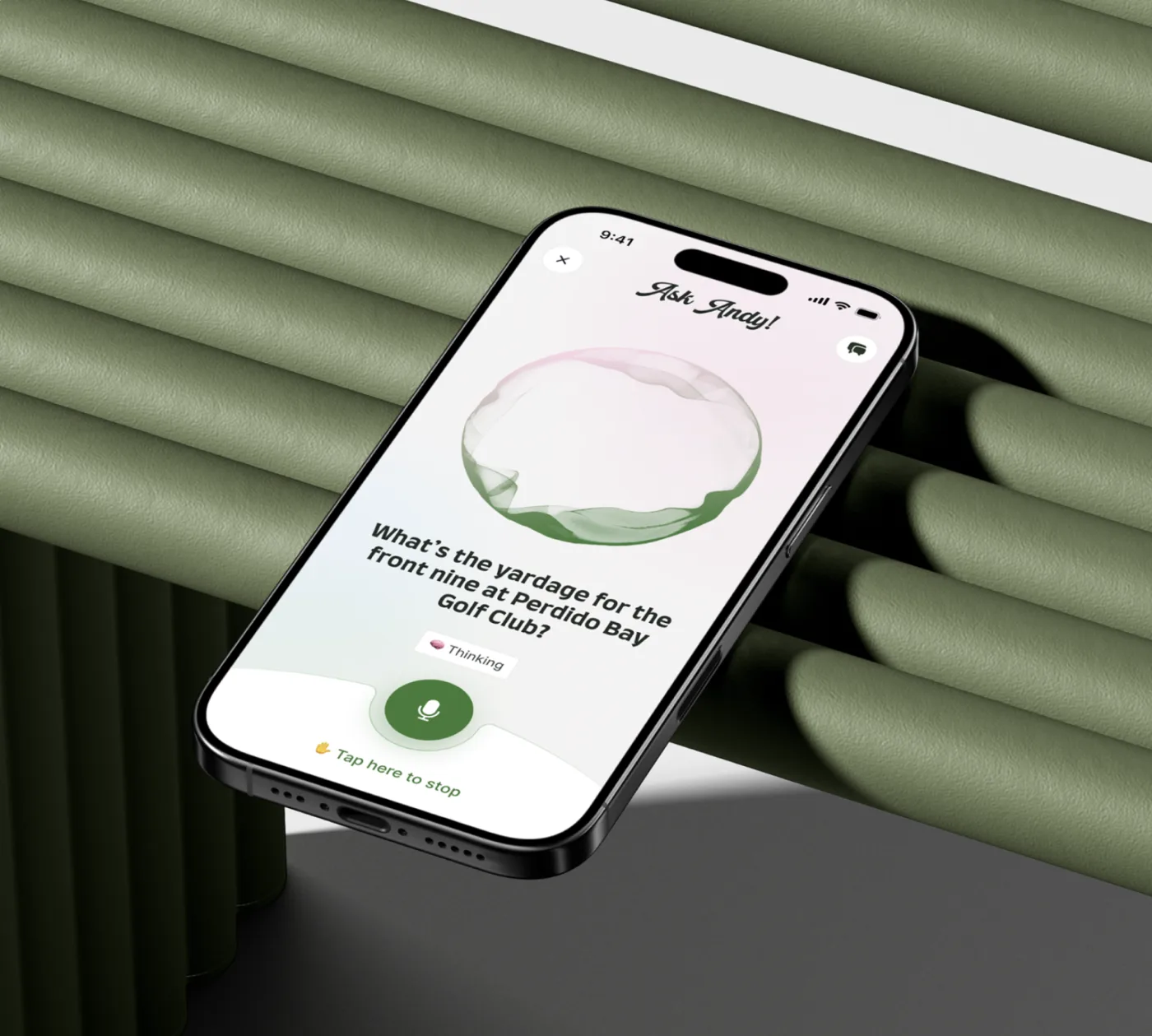
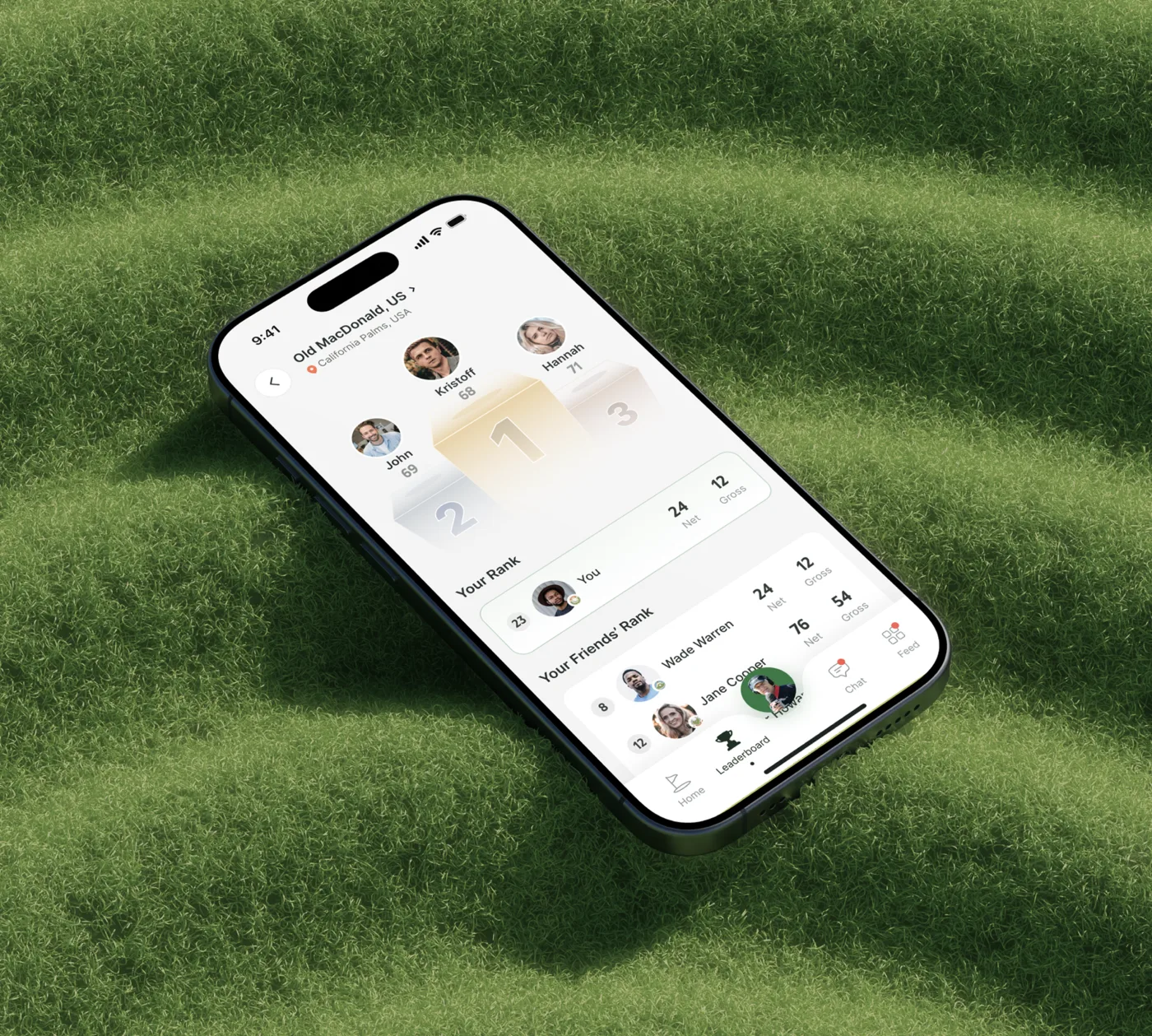
The experience is a continuous cycle.
The golfer plays. Northway captures the round. The product builds context. AI turns that context into guidance. That guidance changes how the next round goes, which creates more context.
Expertise gives the AI a human layer.
Andy North, two-time U.S. Open Champion, is a co-founder and the expert voice behind the virtual caddie. Northway isn't positioned as a generic AI golf assistant. The technology provides the scalability. The expertise gives it character.
What the round is allowed to carry, and what it isn't.
Deciding what belongs mid-round turned out to be the same question as deciding what a golfer can absorb in thirty seconds while holding a club. Almost everything the product knows fails that test, which makes the exclusions more important than the inclusions.
In the round: distance to the target, what the hole asks for, the club the history suggests, and the score as it stands. Each of these answers a question a golfer is already asking themselves out loud.
Out of the round: dispersion charts, strokes-gained breakdowns, trend lines, comparisons against other players. All of it genuinely useful, none of it consumable standing over a ball, all of it waiting on the other side of the eighteenth green.
There is a harder exclusion than any of those. The system has to be willing to say it does not know. A caddie who guesses a yardage to seem useful is worse than no caddie, because a golfer only needs to be wrong once on a confidently delivered number before they stop trusting every number after it. Declining to answer costs an interaction. Answering badly costs the product.
Which is the principle underneath the whole thing. Golf already has enough screens competing for attention. What it does not have is something that knows where you are, what the hole asks for, and what your game history says, and can offer it without asking you to go looking. A caddie. There when it is needed, quiet when it is not, and honest about the difference.