Finiegenie
Financial literacy products think they are competing with school. They are competing with YouTube, for the same forty minutes, against opponents engineered by people who do this for a living. That competitive set is the reason Finiegenie is a game rather than a course.
The competition was never school. It was YouTube.
Most adults learn about money from their first mistake. A credit card that looked manageable until the interest hit. A salary that ran out before the month did. Schools gave them trigonometry instead.
The alternatives exist: YouTube channels, educational apps, school curricula. Most of them are passive. A video explains compound interest once. Passive instruction builds awareness. It does not build the hesitation before a bad financial decision.
There is a second problem, and it is the one that decides whether any of this ships. School is not competing for the child's attention, because attendance is compulsory. Everything built for after school is competing, and it is competing against products with dedicated retention teams. A ten-year-old with a free evening chooses between this and YouTube, Roblox, or a group chat, and none of those are obliged to be good for them. An educational app does not lose to a better educational app. It loses to entertainment, quietly, by never being opened a second time.
Accepting that reframes the whole brief. The format cannot be a compromise between fun and instructional, because the entertainment side of that trade is set by professionals and the bar is not negotiable. Whatever gets built has to survive contact with a bored child who has alternatives.
Games do. A game makes you feel the cost of a wrong choice and the reward of a right one, session after session. Finiegenie applies that mechanic to financial concepts, not by dressing up a lesson as a game, but by making the financial decision itself the gameplay.
Two games, because one format can't do both jobs.
Financial literacy has two distinct layers. Vocabulary: knowing what compound interest means, what an SIP is, how insurance works. And judgment: making a real decision when income, expenses, liabilities, and an uncertain future are all in front of you.
You can't learn vocabulary through simulation, because the feedback loop is too slow. You can't build judgment through trivia, because the stakes are too low. Finiegenie addresses both separately, with a game designed for each.
| Game | Format | What it builds | Reward |
|---|---|---|---|
| Genie Cash | Multiple-choice trivia | Concept recall, financial vocabulary | Coins, badges, leaderboard rank |
| Genie Fortune | Scenario simulation | Applied judgment, decision-making under constraints | Balance growth, leaderboard rank |
Genie Cash: the quiz teaches words.
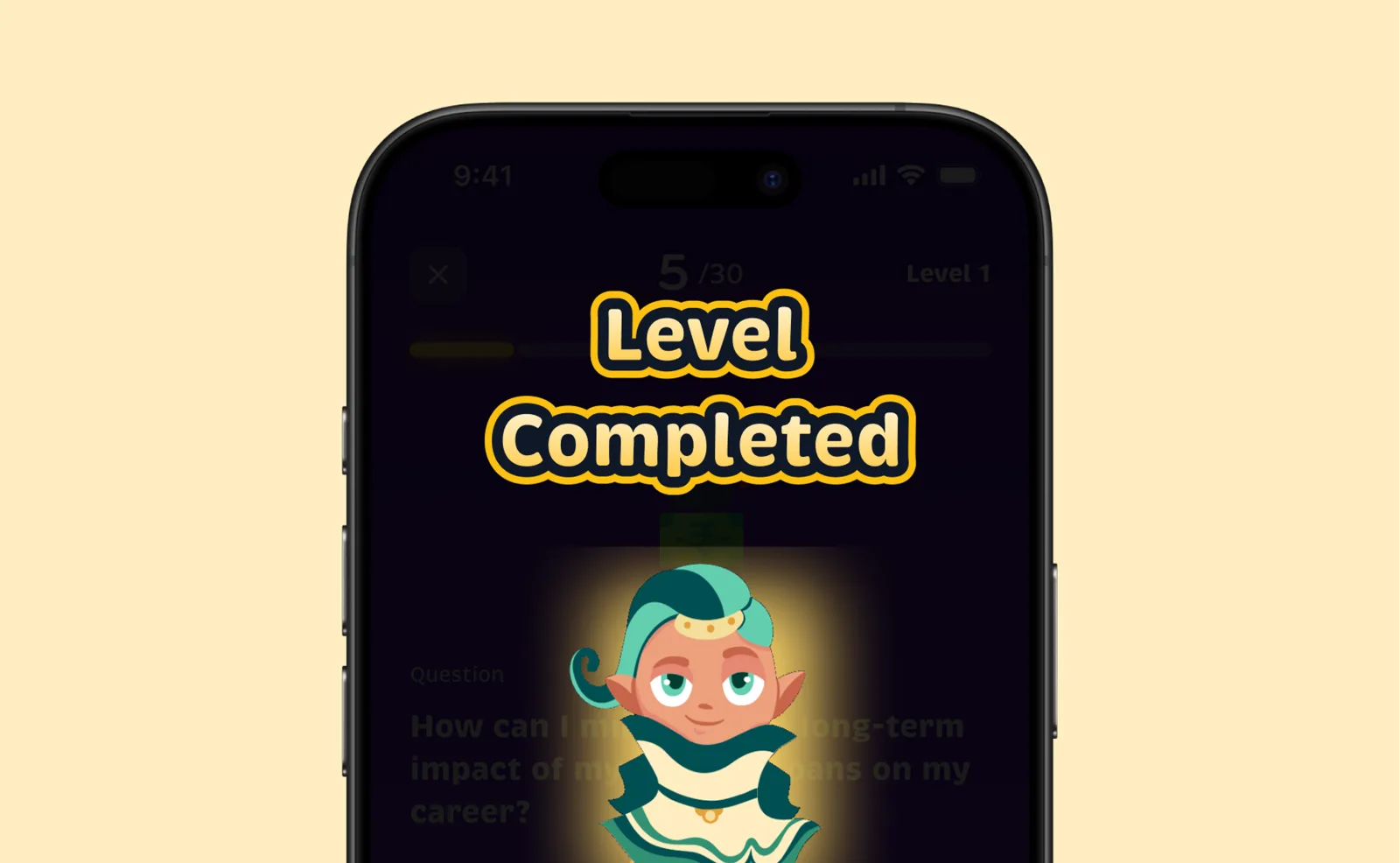
Right answers earn coins. Wrong answers earn feedback, showing the correct answer before moving on. The level structure matters: "I'm on level 8" is a statement about progress that "I've answered 53 questions" isn't. Short levels mean completion feels fast. Each level ends with a global rank, coins collected, and a correct vs. wrong breakdown. Not a punishment, just information about where to go next.
The leaderboard is the retention mechanism. After novelty wears off, what keeps kids coming back is social visibility. A kid who climbed three places has a reason to return next week. Without it, coins and badges become abstract, and abstract rewards don't retain.
Genie Fortune: the simulation teaches judgment.
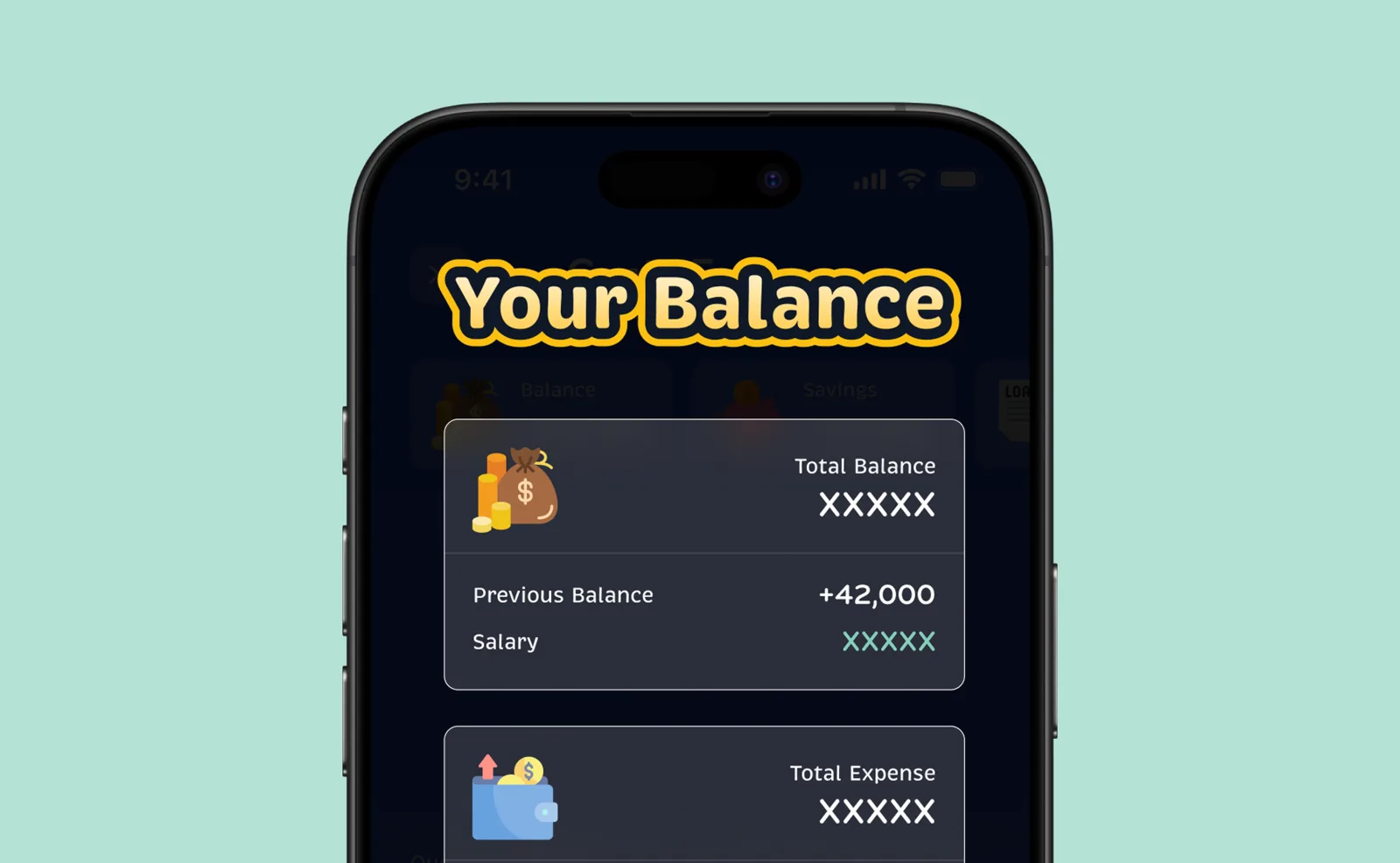
It starts where most real financial journeys do: you've just graduated. The first question arrives immediately: a startup with 15% equity or a stable corporate role at 9 lac per year. The game tracks everything after that. Not as a score. As a ledger.
Your Balance · Genie Fortune
The balance ledger after one decision round in Genie Fortune: income in, expenses out, what remains.
SIP, mediclaim, life insurance. Not toy categories. Categories that appear on actual payslips. Kids encounter "mediclaim" as a live line item that affects their score, not a definition in a glossary. The financial literacy is embedded in the scoreboard. You have to understand the ledger to play the game well.
The leaderboard ranks by balance. The player who invested early, paid off debt faster, chose the right job ends up higher. A kid who plays Genie Fortune for a month and then encounters a real payslip won't see it as a foreign document.
The design had to satisfy two people at once. They want different things.
The person who downloads the app is not the person who uses it. The parent evaluates and installs. The child decides, through daily behaviour, whether it was worth downloading.
- The parent: trust and oversight. Clean onboarding. No dark patterns. No data collected (confirmed in the App Store listing). Multiple child profiles without friction. Content that feels appropriate.
- The child: fun, fast, and rewarding. A mascot. Colours that don't look like a classroom. Avatar selection, a moment of ownership before the first question. Sound effects that signal "this is a game, not a lesson." Rewards that feel earned.
The visual environment shifts at the avatar selection moment. Parent-facing screens are clean and minimal. Once a child's profile is selected, vibrant colour and audio layer in. The handoff is the design: the parent has done their part; the child now owns the experience.
What Finiegenie deliberately doesn't do.
- No ads. A kids' financial literacy app running ads on financial products would be an obvious conflict. The attention a kid brings to a session shouldn't be split.
- No data collection. The App Store listing confirms it. Parents can hand over the device without wondering what's being tracked.
- No passive content. No videos to watch. No articles to read. Every screen requires a choice. Passive content builds awareness; active decisions build habits.
- No "watch an ad for more coins" mechanic. Coins are earned through correct answers, and that causal link is the learning loop rather than a decoration on top of it. Rewarded video is the standard way products like this make money, so declining it removes the obvious revenue model from a free app. It goes anyway, because the moment a coin can be bought with attention instead of earned with a right answer, the app has taught a lesson about money that contradicts everything else in it.